The post NBA Players Are Ready to Return to Basketball. But Are Their Bodies? first appeared on 'CATS STATS.
]]>While many fans are eager to cheer on their favorite players and teams as they head into the home stretch, several players across the league have voiced concerns about the restart, including the increasing number of cases in Florida, the potential to distract from important social justice causes, and the injury risk due to extended time off the court. While all three are significant concerns, this post will attempt to analyze whether fans should expect their favorite teams to be without their best players due to injuries sustained on the court during the restart.
While this represents an unprecedented event in NBA history, we can look back at the 2011 NBA lockout as an imperfect comparison. When the 2005 collective bargaining agreement expired, owners and players were not on the same page financially. The two sides failed to come to an agreement until November 26th and did not end up playing games until Christmas Day—well past the scheduled start date of November 1st. Between July 1st and December 1st, players could not access their team’s facilities, trainers, or staff. Because of the delay, teams had to settle for a shortened training camp and preseason before beginning the season. Many of these developments resonate with what current players are facing as they head into their respective training camps. Thus, if there was a significant uptick in injuries after the 2011 lockout, it is quite possible that there would be a similar increase this year.
To answer this question, I gathered injury data from the site Pro Sports Transactions, which lists transactions across sports leagues such as trades, suspensions, and injuries. I examined data between the 2010-2011 season (one season prior to the lockout one) and the 2018-2019 season (one season prior to this one). I believe that this represents a worthwhile sample to examine injury trends. After compiling the injury information, I divided the data into two—one examining the full season and the other examining just the first eight games of the season. Since each team will be participating in at least the eight seeding games during the restart, it is important to see whether there were more injuries early on in the season before players were fully warmed up. The results can be found in the two charts below:
Full Season
| Season | Games | Days | Injuries | Injuries/Game | Injuries/Day |
| 2010-2011 | 82 | 170 | 910 | 11.09756098 | 5.352941176 |
| 2011-2012 | 66 | 124 | 550 | 8.333333333 | 4.435483871 |
| 2012-2013 | 82 | 170 | 589 | 7.182926829 | 3.464705882 |
| 2013-2014 | 82 | 170 | 575 | 7.012195122 | 3.382352941 |
| 2014-2015 | 82 | 170 | 734 | 8.951219512 | 4.317647059 |
| 2015-2016 | 82 | 170 | 761 | 9.280487805 | 4.476470588 |
| 2016-2017 | 82 | 170 | 910 | 11.09756098 | 5.352941176 |
| 2017-2018 | 82 | 177 | 1200 | 14.63414634 | 6.779661017 |
| 2018-2019 | 82 | 177 | 856 | 10.43902439 | 4.836158192 |
First Eight Games
| Season | Games | Days | Injuries | Injuries/Game | Injuries/Day |
| 2010-2011 | 8 | 22 | 176 | 22 | 8 |
| 2011-2012 | 8 | 21 | 113 | 14.125 | 5.380952381 |
| 2012-2013 | 8 | 22 | 124 | 15.5 | 5.636363636 |
| 2013-2014 | 8 | 21 | 121 | 15.125 | 5.761904762 |
| 2014-2015 | 8 | 21 | 140 | 17.5 | 6.666666667 |
| 2015-2016 | 8 | 22 | 160 | 20 | 7.272727273 |
| 2016-2017 | 8 | 21 | 153 | 19.125 | 7.285714286 |
| 2017-2018 | 8 | 20 | 226 | 28.25 | 11.3 |
| 2018-2019 | 8 | 21 | 115 | 14.375 | 5.476190476 |
Based on the two charts, it is clear that there were not additional injuries during the 2011-2012 lockout season. This holds true when looking at injuries per game and injuries per day across both the entire season and the first eight games. In fact, the lockout year actually had fewer injuries during the first eight games than any other season this decade. This could potentially be explained by players choosing not to play as hard as they ease into the season—something that some teams may have the luxury to do this year but certainly not others.
While the conclusions of this brief study pose a more optimistic view for potential injuries during the NBA’s restart, there are certainly some other factors to consider. As mentioned earlier, the circumstances surrounding the 2011 lockout and this year are quite different. While players did not have access to their typical resources from their teams, they still had the ability to play competitive basketball during their time off. Some players chose to play overseas, others engaged in pick-up games with teammates, while others held organized workouts with their teammates. These luxuries were not available to players during this year’s hiatus. In addition, only information regarding the number of injuries was available for this study. It is possible that, while there were not more injuries during the lockout season, the ones that were suffered were more severe. This hypothesis is supported by a study conducted after the 2011 NFL lockout, as well as the fact that the NBA is providing players with additional insurance in case of career-threatening injuries sustained during the restart. So, while fewer players may get injured during the final couple of months of the NBA season, a lot could still go wrong for players during these uncertain circumstances.
The post NBA Players Are Ready to Return to Basketball. But Are Their Bodies? first appeared on 'CATS STATS.
]]>The post Duncan Robinson: D3 to NBA Sharpshooter first appeared on 'CATS STATS.
]]>After sitting out a year per NCAA regulations, Robinson got off to a hot start in his sophomore season at Michigan, scoring 19 points in his second game without missing a shot. He ended up starting 27 of the 36 games that season, averaging 11.2 PPG and shooting 45% from three. After quite a successful first year at Michigan, Robinson took somewhat of a step back in his junior year, only starting three of the 38 Michigan games during the 2016-2017 season. While his team enjoyed great success—winning the Big Ten Tournament and then reaching the Sweet 16—Robinson only averaged 7.7 PPG while his three-point percentage dropped slightly from 45% to 42.4%. His overall field goal percentage, however, climbed from 45.7% to 47% as a result of his improved shooting from two-point range. His senior season was mostly more of the same for Duncan, as he found his way in and out of the starting lineup on a dominant Michigan team that reached the NCAA Tournament championship game before losing to Villanova. During the 2017-2018 season, he averaged 9.2 PPG, while his three-point percentage fell to 38.4%. His minutes did increase, however, from his junior season, increasing from 20.1 MPG to 25.8 MPG.
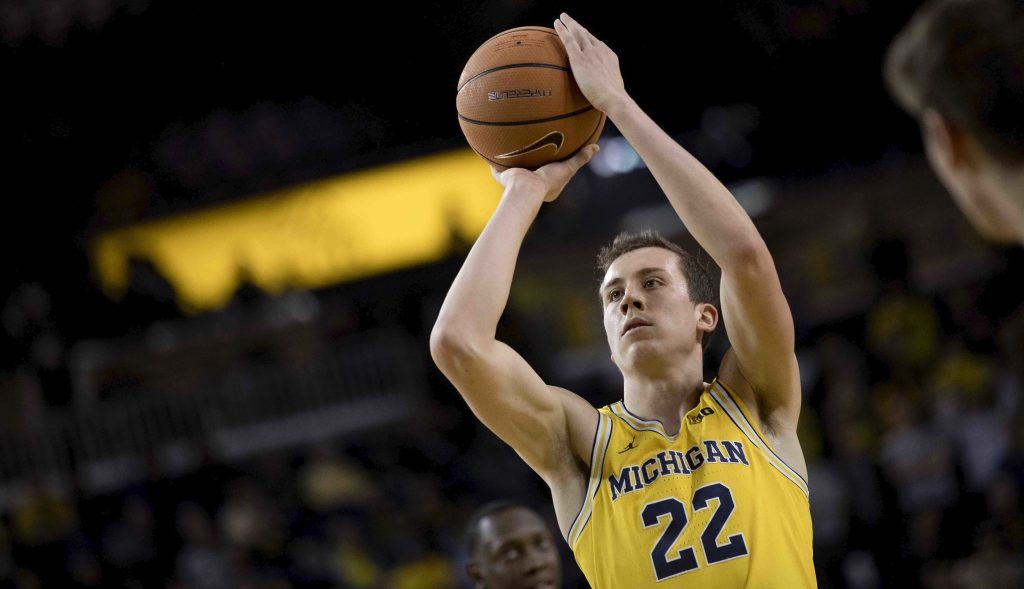
After a mostly successful but also up and down college career, Duncan Robinson went undrafted in the 2018 NBA Draft and eventually signed a Summer League deal with the Miami Heat. Because of his strong shooting performance during his five Summer League games, the Heat offered Robinson a two-way contract, giving him the opportunity to play with both their G-League and NBA teams. Robinson spent the 2018-2019 NBA season between Sioux Falls and Miami. He played in 15 total games for the Heat, averaging 3.3 PPG in 10.7 MPG, though he did not shoot particularly well—Robinson only shot 39.1% from the floor and 28.6% from beyond the arc. Heading into this season, however, the team felt confident about his potential to succeed in the league and were ultimately proven correct. He has put forth a fantastic season thus far, averaging 29.8 MPG and starting 58 of the 63 Heat games this year. He has also averaged 13.1 PPG while shooting 46.8% from the field and 90% from the free throw line. The big storyline—one that has recently made a lot of headlines—has been his incredible three-point shooting. Robinson has made 44.9% of his three-point attempts while attempting 8.2 threes a game. He even represented his team in the three-point contest over All Star Weekend. His numbers represent a huge jump from last season—when he made only 10 total threes—to this one—in which he has made 233 threes so far. Per ESPN Stats & Info, the 223 three-point field goal increase from one season to the next is currently tied with George McCloud for the greatest increase in NBA history! Not too shabby for a player who began his college career at a Division III school.
The post Duncan Robinson: D3 to NBA Sharpshooter first appeared on 'CATS STATS.
]]>The post Risers and Fallers in March Madness first appeared on 'CATS STATS.
]]>Last week, Cats Stats posted on article looking at the Sweet 16 via the Efficiency Landscape, which was based on the following tweet by Kirk Goldsberry looking at the efficiency landscape of the NBA.
The Efficiency Landscape. Last 15 Games. What Jumps Out? pic.twitter.com/Uhevm79ZmR
— Kirk Goldsberry (@kirkgoldsberry) March 24, 2019
Similar to the visualization in last week’s article , the new graph displays the pre-tournament KenPom rankings of all 68 teams in this year’s NCAA Tournament field based on their adjusted efficiency.
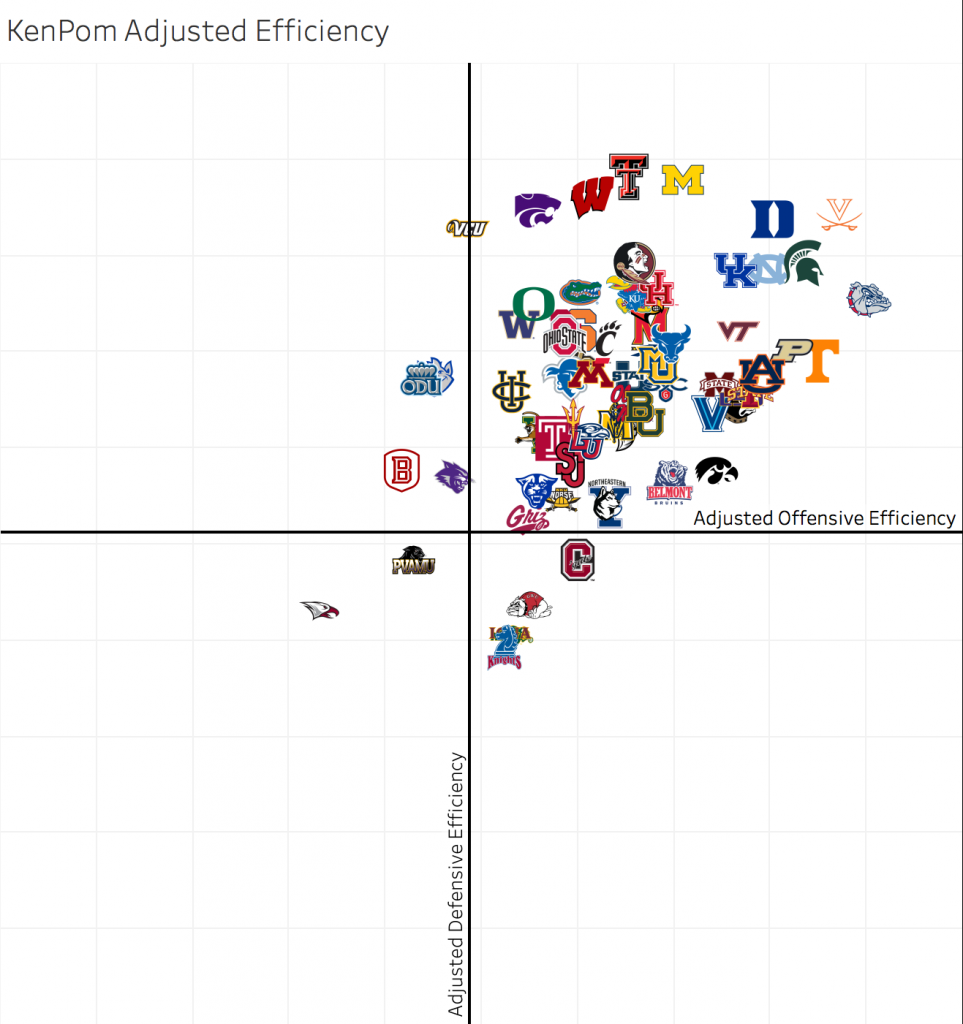
As you can see, most of the teams are located in the top right quadrant of the graph, indicating that they had above-average adjusted offensive and defensive efficiency. The teams whose adjusted efficiency margin has increased the most since the start of the tournament include Texas Tech, Oregon, UCF, Houston, and Auburn. The teams whose adjusted efficiency margin has decreased the most since the start of the tournament are Marquette, Wisconsin, Louisville, UNC, and—surprisingly—Virginia.
At the beginning of the tournament, Virginia ranked 1st in KenPom’s adjusted efficiency margin, ranking 2nd in adjusted offensive efficiency and 5th in adjusted defensive efficiency. Despite dropping down in the adjusted efficiency margin metric (from 35.66 to 34.23), Virginia still remains well ahead of the competition and has retained their #1 overall ranking. They have the same adjusted offensive and defensive efficiency rankings as well. In other words, despite some close games against inferior teams (e.g. Oregon), the Cavaliers remain KenPom’s favorite to win it all.
Michigan State began the tournament ranked 4th in KenPom’s adjusted efficiency metric, ranking 4th on the offensive side of the ball and 8th on the defensive side of the ball. As a 2 seed, they were actually ranked ahead of 1 seed UNC in adjusted efficiency. The Spartans’ status has hardly changed since then—their adjusted efficiency margin increased from 31.36 to 31.50—but they have surpassed Duke after defeating them and moved up to 3rd in KenPom’s rankings.
As indicated above, Texas Tech has been a significant riser during the NCAA Tournament, increasing their adjusted efficiency margin from 26.75 to 29.53. They have also moved up from 9th to 5th in KenPom’s rankings. The Red Raiders have improved on both sides of the ball, improving their adjusted offensive efficiency ranking from 36th to 30th and improving their already dominant defense, maintaining their status as KenPom’s highest ranked defensive team.
Auburn has been another significant riser during the tournament, as they increased their adjusted efficiency margin from 23.33 to 24.70. Their strong offense has improved even further, moving from 8th to 6th in adjusted offensive efficiency, while their defense has not changed significantly since the beginning of the tournament. With a Virginia offense that ranks 2nd in adjusted offensive efficiency, the Tigers’ defense (currently ranked 38th in adjusted efficiency) will surely be tested.
All in all, the Final Four produced four outstanding teams, with none of them ranked below 13th in KenPom’s pre-tournament evaluations. Looking ahead to the next round of games on Saturday, KenPom gives Virginia a 70% chance to win their matchup against Auburn, while Michigan State has a 55% chance of taking down Texas Tech. One can only hope that those games will be as thrilling as this weekend’s Elite Eight games.
The post Risers and Fallers in March Madness first appeared on 'CATS STATS.
]]>The post Michigan State Comes Back to Defeat Rival Michigan first appeared on 'CATS STATS.
]]>Saturday’s game marked the second meeting between the two teams this season, as Michigan State beat their rivals on the road on February 24. Both teams are relatively balanced on both sides of the ball, as the Spartans currently rank 4th in KenPom’s adjusted offensive efficiency and 9th in adjusted defensive efficiency, and the Wolverines rank 18th in offensive and 2nd in defense.
Despite falling behind early, the Spartans were able to turn it around in the second half and win comfortably. A key factor in the game was the free throw disparity, as Michigan State had 30 attempts compared to Michigan’s seven. The Spartans were able to convert 23 of their 30 opportunities (76.7%), which is right around their season average of 74.5%. The Wolverines predictably fell into foul trouble, with leading scorer Ignas Brazdeikis fouling out with five minutes remaining in the game.
While Michigan State is typically a great passing team—their assist percentage of 67.8% ranks first in the nation—they did not record as many assists as usual. Part of that can be explained by their high free throw numbers, but they did only assist on 12 of their 23 made field goals (52.2%). Nonetheless, junior point guard Cassius Winston led the team with seven of the 12 assists. Three of them went to senior forward Kenny Goins, two went to sophomore big man Xavier Tillman, and the rest went to senior guard Matt McQuaid and freshman forward Aaron Henry. Henry also contributed with two assists—one each to Tillman and freshman big man Thomas Kithier.
With this win, the Spartans clinched the #1 seed in the Big Ten Tournament. Michigan, on the other hand, dropped to the #3 seed with the loss. Both teams stand to gain high seeds in the NCAA Tournament as well—Joe Lunardi had both teams as two seeds prior to their Saturday meeting.

The post Michigan State Comes Back to Defeat Rival Michigan first appeared on 'CATS STATS.
]]>The post UNC Defeats #1 Duke at Cameron first appeared on 'CATS STATS.
]]>Both teams sport strong offenses complemented with equally strong defenses, with Duke ranking top five in adjusted offensive and defensive efficiency and Carolina ranking top ten in both categories. Both teams also push the tempo, as Carolina ranks 3rd in average possession length and 5th in adjusted tempo, while Duke ranks 11th in average possession length and 16th in adjusted tempo.
One of the game’s most talked about moments occurred a mere 30 seconds in when Duke star freshman Zion Williamson tore through his shoe and sprained his knee, forcing him to leave the game for good. That was just the start of a strange and surprising game.
The Tar Heels, who rank 43rd in the nation in three-point percentage at 37.6%, made only two of their 20 attempts (10%). However, they managed to hit 65.5% of their two-point attempts, well above their season average of 52.7%. The Blue Devils, on the other hand, were not able to consistently hit their shots during the frustrating loss. Despite ranking 328th in the nation in three-point percentage at 30.6%, they were not able to achieve this mark and made only eight of their 39 attempts (20.5%). They did, however, hit 51.5% of their two pointers, although this was below their season average of 58.5% (4th in the nation).
UNC demonstrated their typical tremendous passing in this game—they rank 13th in the nation in assists per field goals made—leading to many open looks, especially in the paint. Senior wings Cameron Johnson and Kenny Williams led the team with four assists each. Two of Johnson’s assists went to senior big man Luke May, while the other two went to freshman point guard Coby White and Kenny Williams. Williams demonstrated a similar assist pattern, as two of his went to Maye, one went to White, and his final one went to Cameron Johnson. Point guard Coby White had three assists, with two going to Maye and the last going to Johnson. Finally, junior point guard Seventh Woods contributed with three assists, two of which went to sophomore forward Garrison Brooks and the last going to Luke Maye.
Both of these teams played another game over the weekend and put forth convincing performances. The Tar Heels soundly defeated #16 Florida State at home, while the Blue Devils bounced back and avenged their home loss against Syracuse with a 10-point road win. Duke hopes to get their star freshman back soon, as they have a challenging road matchup against #20 Virginia Tech on their schedule before facing the Tar Heels again on their home turf on March 9th. UNC, meanwhile, looks to continue their hot streak in advance of their next showdown against their rival.

The post UNC Defeats #1 Duke at Cameron first appeared on 'CATS STATS.
]]>The post Kentucky Earns Strong Win Over #1 Tennessee first appeared on 'CATS STATS.
]]>Kentucky utilized a balanced approach in this game, demonstrating their prowess on both sides of the ball. The Wildcats currently rank as KenPom’s 5th best team in the nation, standing at 14th in adjusted offensive efficiency and 8th in adjusted defensive efficiency. In this game, they managed to shoot 54.7% from the field, including 38.5% from three while holding the Volunteers to an uncharacteristically poor offensive performance. Tennessee, which ranks 2nd in KenPom’s adjusted offensive efficiency ratings, shot only 40.7% from the field while making seven of their 25 three-point attempts (28%).
The Wildcats finished the game with 14 assists, with freshman point guard Ashton Hagans accounting for half of the team’s total. Of Hagans’ seven assists, five went to freshman wing Keldon Johnson, while the other two went to sophomore forward PJ Washington and freshman wing Tyler Herro. Herro also contributed with three assists, all contributing toward PJ Washington’s team high 23 points.
With this win, Kentucky has closed the gap on a tight SEC race. The Wildcats currently sport a 10-2 conference record (21-4 overall) and trail only LSU (11-1, 21-4) and Tennessee (11-1, 23-2) in the SEC standings. Kentucky dropped a close one to LSU this past week at Rupp but still has time to make up ground. As a team with strong wins over UNC, Louisville, Kansas, and now Tennessee, the Wildcats are clearly a dangerous team and have now moved up to #4 in this week’s AP Poll. The Volunteers have strong wins on their resume as well, defeating Louisville and Gonzaga and have only lost two games—to Kansas and Kentucky. Both Kentucky and Tennessee (now ranked #5 in the AP Poll) should gain high seeds in both the SEC Tournament and the NCAA Tournament, with hopes of winning both.

The post Kentucky Earns Strong Win Over #1 Tennessee first appeared on 'CATS STATS.
]]>The post Duke Sweeps Virginia first appeared on 'CATS STATS.
]]>On the same day that the NCAA selection committee named Duke as their #1 overall seed in their current tournament rankings (Virginia came in as the third #1 seed), the Blue Devils earned a monster road win to further enhance their impressive resume. In the first meeting between these two ACC powerhouses, the Blue Devils edged the Cavaliers at home 72-70. This game was not as close as the first, as a dominant performance by Duke right out of the gate pushed them to a 10-point road win.
This game featured an interesting clash in offensive styles, as Duke ranks 12th in the nation in average possession length and 20th in adjusted tempo. Virginia, on the other hand, ranks 351st (out of 353 teams) in average possession length and dead last in adjusted tempo. Despite the opposing styles, these two teams both rank very highly in KenPom’s adjusted offensive and defensive efficiency. The Blue Devils come in at 2nd on the offensive side and 5th on the defensive side, while the Cavaliers rank 5th on the offensive side and 3rd on the defensive side.
A major factor in Duke’s win was their ability to knock down perimeter shots, both contested and uncontested. The Blue Devils shot the lights out, making 26 of their 45 shots from the field (57.8%) and an incredible 13 of their 21 shots from three (61.9%). This performance was certainly surprising, as their three-point shooting had been viewed as one of their few weaknesses—on the year, they rank 283rd in the nation at 32%. Virginia had a solid offensive performance in their own right (46.7% from the field and 41.7% from three) but had little chance to keep up with Duke’s high-scoring offense.
The Blue Devils distributed the ball well in this one, finishing with 18 assists. Freshman point guard Tre Jones led the team with seven assists, with four going to freshman wing RJ Barrett, two going to freshman wing Cam Reddish, and the final one going to junior forward Jack White. Star freshman forward Zion Williamson contributed with five assists, with two each going to Barrett and Reddish, and the last one going to junior center Marques Bolden. Barrett and Reddish also distributed three assists each.
Both Duke and Virginia currently have two losses, as Duke lost two close ones to Gonzaga and Syracuse, while Virginia dropped both of its contests to Duke. After this game, the Blue Devils jumped the Cavaliers for KenPom’s #1 team, while Virginia currently stands at #3. With a grueling ACC schedule ahead for both teams, there should be many more exciting games and great challenges.

The post Duke Sweeps Virginia first appeared on 'CATS STATS.
]]>The post After Seven-Game Losing Streak, Indiana Stuns #6 Michigan State first appeared on 'CATS STATS.
]]>Prior to the game’s start, KenPom gave the visiting Hoosiers a 5.1% chance of taking down the Spartans. Prior to this game, Michigan State had a 10-0 record at home, while Indiana had a 1-7 record on the road. Coupled with the fact that Indiana was also on a seven-game losing streak, the outcome of this contest was no doubt surprising.
The Hoosiers did not shoot the ball particularly well from the field (28-72, or 38.9%) but made up for it with stellar three-point shooting (10-20). The Spartans, on the other hand, had a solid shooting performance, making 29 of their 64 shots from the field (45.3%) and 9 of their 21 from beyond the three-point line (42.9%). However, their free throw numbers left a lot to be desired, as they only converted 8 of their 22 opportunities (36.4%). This was an atypical, but costly, performance at the line for the Spartans, who shoot 71.7% on the season.
The Hoosiers recorded 21 assists in their exciting overtime win. Junior point guard Devonte Green came off the bench to lead the way with five assists, with three going to sophomore forward Justin Smith and the other two going to senior forward Juwan Morgan and sophomore guard Aljami Durham. Junior big man De’Ron Davis also came off the bench to contribute four assists, with two going to Green and the others going to Durham and freshman wing Romeo Langford. Langford dished out four assists as well, with two going back to Davis and the other two going to Devonte Green and freshman big man Jake Forrester.
Despite posting a seven-game losing streak and holding a 4-7 conference record, the Hoosiers remain very much alive in the hopes of an NCAA Tournament bid. Because of their significant wins against Marquette, Louisville, and now Michigan State, Indiana has positioned themselves for a tournament bid. Prior to their win against Michigan State, ESPN’s Joe Lunardi had listed them as one of the last four teams to make the tournament in his projections. Now, they have the opportunity to further improve their standing with the selection committee throughout the rest of their Big Ten conference games. Michigan State, on the other hand, remains in prime position to gain a high seed in the tournament despite this loss. Though they have dropped back to back games, the Spartans post a 18-4 record and are 9-2 in their conference. Lunardi had projected them as a two seed prior to the loss.

The post After Seven-Game Losing Streak, Indiana Stuns #6 Michigan State first appeared on 'CATS STATS.
]]>The post Battle for #1 – Davidson Defeats Saint Louis in Defensive Battle first appeared on 'CATS STATS.
]]>Another game, another strong defensive showing by Davidson. The Wildcats held the Billikens to 34.7% from the field, including 6-22 (27.3%) from three. Davidson was able to shoot slightly better than Saint Louis, at a tick of 39.5% from the field and 9-26 (34.6%) from three. A close game was to be expected, as both teams head into this game with identical records of 14-5 overall and 5-1 in the conference. A defensive showdown was also expected, as the Wildcats rank 62nd in the nation in adjusted defensive efficiency, while the Billikens rank 18th.
Despite their poor shooting, Saint Louis did manage to gain an advantage on the offensive boards. Ranking 26th in the nation in offensive rebounding percentage, the Billikens picked up 15 in this game while allowing just four Davidson offensive boards. These boards led to extra possessions for Saint Louis and kept the game close. Down the stretch, however, poor free throw shooting plagued the home team, as they shot just 13-20 (65%) from the line. This includes two crucial misses in the closing seconds that could have tied or won game for Saint Louis. Free throw issues have crippled the Billikens all year, as their cumulative 60.4% ranks 348th out of the 353 Division I teams.
Davidson assisted on 14 of their 17 made buckets, for a great assist percentage of 82.4%. Dusan Kovacevic led the team with a season-high four assists. Two of his assists went toward Jon Axel Gudmundsson’s incredible 27-point total, while the other two went to Kellan Grady and Luke Frampton. Frampton contributed with three assists as well—two going to Jon Axel Gudmundsson and the other going to Bates Jones. KiShawn Pritchett and Carter Collins also distributed two assists each.
Davidson currently stands in second place in the Atlantic 10 with a 6-1 record. Looking down the road, the Wildcats are favored to win every one of their games except for their February 22nd road showdown with Rhode Island, according to KenPom.

The post Battle for #1 – Davidson Defeats Saint Louis in Defensive Battle first appeared on 'CATS STATS.
]]>The post Wild Week Sees #2 Michigan Lose to Wisconsin first appeared on 'CATS STATS.
]]>Despite the fact that Michigan was ranked second in the country and Wisconsin was unranked, this was a closer game on paper than one might have thought. Wisconsin ranks as KenPom’s 16th best team, ranking at 32nd in adjusted offensive efficiency and 10th in defensive efficiency. Michigan, on the other hand, stands as KenPom’s 6th best team, ranking at 25th in adjusted offensive efficiency and 3rd in adjusted defensive efficiency. With home court advantage in Wisconsin’s favor, KenPom gave Michigan just a slight pregame edge (52.6% chance to win).
In terms of the game itself, it was no surprise that there would be some offensive struggles given the teams’ strong defenses. The Wolverines were held to 40.7% from the field and 27.8% (5-18) from three. The Badgers faired a little better, as they shot 44.8% from the field, including 38.5% (5-13) from beyond the arc. Wisconsin has been a great three-point shooting team this season, coming in at 18th in the nation at 39.1%. Some good passing and solid three-point shooting helped Wisconsin take down the #2 team in the country.
Senior center Ethan Happ was the star of the game, contributing with 26 points, 10 rebounds, and seven assists. Happ dished out two assists each to sophomore guard Brad Davison, sophomore forward Nate Reuvers, and freshman wing Kobe King. His final assist went to sophomore forward Aleem Ford. Davison distributed three assists—two to Happ and one to Reuvers. Finally, sophomore point guard D’Mitrik Trice contributed with three assists as well, two to Happ and one to Davison.
Even after the big win, Wisconsin still has a lot of ground to catch up in the Big Ten race. The Wolverines are currently tied for 6th place with a 4-3 conference record. Meanwhile, Michigan stands in 3rd place with a 6-1 record, placing behind Michigan State and Maryland. Since it is still early, both teams have time to catch up and improve their standings in the NCAA tournament.

The post Wild Week Sees #2 Michigan Lose to Wisconsin first appeared on 'CATS STATS.
]]>